
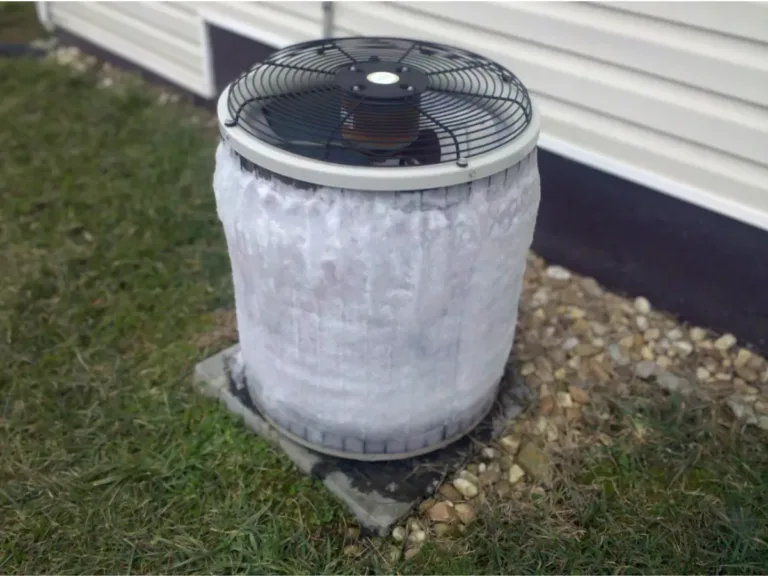
You notice ice on your refrigerant lines. Or water pooling under your indoor unit. Or your AC is running but barely cooling. These are all signs your system has frozen up — and in Raleigh’s hot, humid summers, it’s more common than most homeowners expect.
High humidity means more moisture in the air passing over your evaporator coil. More moisture means more opportunity for ice to form when something goes wrong. Here’s what causes it and exactly what to do.
Quick Takeaways
1 A frozen AC is almost always caused by restricted airflow or a refrigerant problem—check the filter first.
2 Running your AC when outdoor temps drop below 60°F can cause freezing.
3 A dirty evaporator coil is a common cause that most homeowners don’t think to check.
4 If you see ice, turn the system off immediately—running a frozen AC can destroy the compressor.
5 Most causes require a technician. The thaw you can do yourself—the fix usually requires a pro.
5 Reasons Your AC Is Freezing Up
1. Restricted Airflow
This is the most common cause. Your evaporator coil needs a steady flow of warm air moving across it to stay above freezing. When that airflow drops — from a clogged filter, blocked return vents, or closed supply registers — the coil gets too cold and moisture in the air freezes on contact.
Start with the air filter. If it’s gray and clogged, that’s likely your culprit. Replace it and check that all your supply and return vents are open and unobstructed — furniture, rugs, and drapes are frequent offenders.
Filters should be changed every 1-3 months. During Raleigh summers when the system runs constantly, lean toward the shorter end of that range.
2. Low Refrigerant / Refrigerant Leak
Refrigerant doesn’t get consumed — if your system is low, there’s a leak. When refrigerant levels drop, pressure inside the evaporator coil drops with it. Lower pressure means lower temperature, and the coil can drop well below freezing and ice over even when airflow is fine.
Signs of a refrigerant issue alongside the ice: the system runs for a long time without cooling, you hear hissing or bubbling near the refrigerant lines, or you’ve had this problem before and it keeps coming back.
This is not a DIY fix. The leak has to be located and repaired before recharging — otherwise you’re just delaying the same problem. Call a technician.
3. Dirty Evaporator Coil
Even with a clean filter, the evaporator coil accumulates a thin layer of dust and grime over time. That layer acts as insulation, reducing the coil’s ability to absorb heat from the passing air. The coil temperature drops, moisture freezes, and the ice builds up layer by layer until airflow is blocked almost completely.
This is one of the more overlooked causes because it develops gradually. A system that froze up once a season last year might now be freezing every few weeks. A coil cleaning is part of a proper annual AC tune-up — one of the better arguments for not skipping it.
4. Running the AC When It’s Cool Outside
Most residential AC systems aren’t designed to operate efficiently when outdoor temperatures drop below 60 degrees. At lower ambient temperatures, refrigerant pressure drops and the coil can freeze even if everything else in the system is working correctly.
This catches people off guard in spring and fall — a cool night in April or October, windows open all day, then the AC kicks on in the evening and freezes up. If nighttime temps are dropping into the 50s, turn the AC off and open windows instead. It’s not a malfunction. It’s the system operating outside its design range.
5. Blower Motor Failure
The blower motor is what pushes air across the evaporator coil and through your ductwork. If it’s failing — running slowly, cycling on and off, or not running at all — airflow drops and the coil freezes for the same reason as a clogged filter: not enough warm air moving across it.
A failing blower often gives warnings before it quits entirely: weak airflow from vents even with a clean filter, unusual noises from the air handler, or a system that freezes up repeatedly without an obvious cause. This is a mechanical failure that needs a technician to diagnose and repair.
What to Do Right Now: The Thaw Protocol
None of the other articles on this topic walk you through the actual steps. Here’s exactly what to do when you find a frozen AC:
- Turn the system off at the thermostat. Do not leave it running. A frozen coil forces the compressor to work harder than it was designed to, and a dead compressor is a very expensive problem.
- Switch the fan setting to “On” (not “Auto”). This keeps the blower running without the cooling cycle, which helps push warm air across the coil and speeds up the thaw.
- Wait 2-4 hours. Depending on how much ice has built up, a full thaw can take anywhere from 1 hour to most of a day. Don’t rush it with a heat gun or hair dryer — you can damage the coil fins.
- Put towels around the indoor unit and check the condensate drain pan. A significant thaw produces a lot of water. If the drain pan overflows, you’ll have water damage to deal with on top of the original problem.
- Replace the air filter once the ice is gone, before you restart the system.
- Turn the system back on and monitor it. If it cools normally and stays that way, a dirty filter was likely the cause. If it freezes again within 24-48 hours, the underlying problem — low refrigerant, dirty coil, failing blower — needs a technician.
What Happens If You Ignore It
A frozen coil left running doesn’t just stay frozen — it gets worse. Ice builds up until airflow is completely blocked. The compressor, now starved of the refrigerant return it needs to stay cool, begins to overheat. Compressor failure is the most expensive single repair in an HVAC system, often costing more than the system is worth on an older unit.
Ice melt is also a water damage risk. The condensate drain pan has a limited capacity. If the thaw produces more water than the pan and drain line can handle, that water ends up in your ceiling, walls, or floor — depending on where your air handler is installed.
The frozen coil itself is a symptom. Ignoring the cause means it happens again, and each cycle puts more strain on the compressor.
Frequently Asked Questions
Why is there ice on my AC unit?
Ice forms on the evaporator coil when it drops below 32 degrees Fahrenheit. This happens when airflow is restricted (dirty filter, blocked vents), refrigerant levels are low, the evaporator coil is dirty, or the system is running in cool outdoor temperatures. The moisture in the air passing over the coil freezes on contact and accumulates into visible ice.
Can I run my AC with ice on it?
No. Turn it off immediately. Running a frozen AC forces the compressor to operate under abnormal conditions and can cause permanent compressor damage. Switch the fan to “On” to help it thaw, but keep the cooling cycle off until the ice is completely gone and you’ve addressed the underlying cause.
How long does it take for a frozen AC to thaw?
Typically 1-4 hours for a minor freeze. A heavily iced system can take 24 hours or more to thaw completely. Running the fan on “On” mode speeds the process. Do not use heat guns, hair dryers, or any external heat source to accelerate the thaw — the coil fins are delicate and easily damaged.
Why does my AC keep freezing up even after I thaw it?
If your system freezes repeatedly, a dirty filter or blocked vent is rarely the cause — those are one-time fixes. Recurring freeze-ups almost always point to low refrigerant (meaning there’s a leak somewhere in the system), a dirty evaporator coil that needs professional cleaning, or a failing blower motor. All three require a technician to diagnose and repair properly.
Is a frozen AC covered by my home warranty?
It depends on the cause and your specific warranty terms. Mechanical failures like a blower motor or compressor are typically covered. Refrigerant leaks and associated repairs may or may not be, depending on the policy. Maintenance-related causes — like a coil that froze because it was never cleaned — are often excluded. Check your warranty documentation or call your provider directly.
Still Freezing Up? We Can Help.
A frozen AC in a Raleigh summer isn’t something to wait out. All American Heating, Air & Plumbing has served the Triangle since 2001.
Our HVAC technicians in Raleigh, NC diagnose the actual cause — not just thaw it and leave — and we offer same-day service for cooling problems that can’t wait.