
Your AC doesn’t consume refrigerant the way a car burns gas. It circulates the same charge in a closed loop, over and over, absorbing heat from your indoor air and releasing it outside.
If that charge drops, there are only two explanations: a leak somewhere in the system, or the unit was undercharged when it was installed. Either way, the symptoms show up fast, and they get worse the longer you wait.
Here’s what to look for and, just as important, what each symptom means you should do about it.
Quick Takeaways
1 Low refrigerant doesn’t fix itself. It always means a leak or an installation error.
2 The most visible sign is ice where ice shouldn’t be: on the refrigerant lines or the indoor coil.
3 Some symptoms call for a service appointment this week. Ice or hissing sounds mean turn the system off and call now.
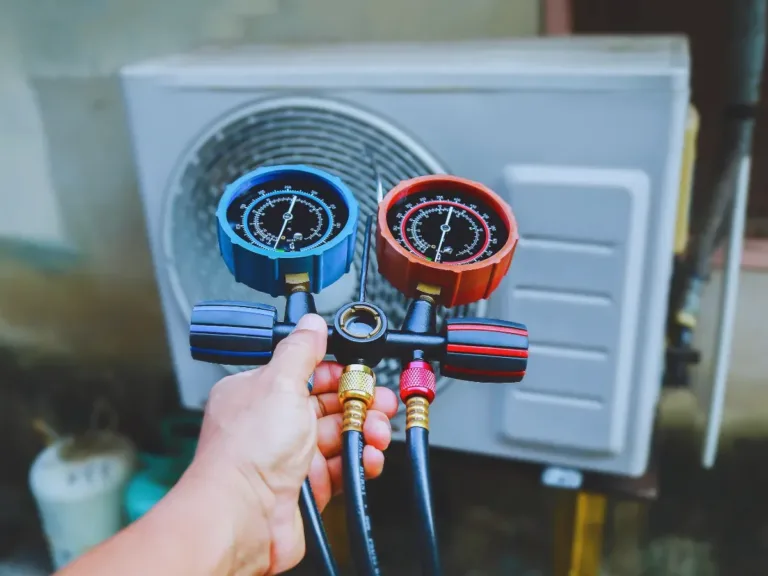
4 A technician with pressure gauges is the only way to confirm low refrigerant. Everything below helps you recognize it early enough to prevent compressor damage.
If your AC is already struggling and you need a diagnosis, schedule an AC repair diagnosis with our NATE-certified technicians.
1. The Air From Your Vents Feels Warm or Lukewarm
Put your hand up to a supply vent while the system is running. If the air feels room temperature or barely cool, that’s one of the earliest and most obvious symptoms of low refrigerant in an AC unit. There simply isn’t enough refrigerant in the evaporator coil to absorb heat from the air passing over it, so the system circulates air that’s barely been cooled.
This is easy to confuse with a dirty filter or a thermostat problem. The difference: if you’ve checked the filter, confirmed the thermostat is set to cool (not “auto” or “fan only”), and the air still isn’t cold, refrigerant is a likely suspect.
What to do: Schedule a service call this week. The system is working harder than it should be, but it’s not in immediate danger.
2. Your Home Can’t Reach the Thermostat Setting
Your thermostat says 74. Your house is stuck at 79 and won’t budge, even after hours of running. The system isn’t broken in the traditional sense. It’s running. The fan works. Air comes out. But the cooling capacity is diminished because there isn’t enough refrigerant to transfer heat effectively.
This is different from symptom #1. In that case, the air itself feels wrong at the vent. Here, the air may feel slightly cool, but the system simply can’t remove enough heat from the space to pull the temperature down. On a 95-degree Raleigh afternoon with high humidity, a system that’s low by even a pound or two of refrigerant can fall behind and never catch up.
What to do: Schedule a service call. Don’t lower the thermostat further. That just forces the system to run longer without fixing the problem.
3. Ice Is Forming on the Refrigerant Lines or Indoor Coil
This one surprises people. It’s the middle of summer. Why is there ice on your AC?
When refrigerant drops below the designed charge level, the pressure inside the evaporator coil drops with it. That drives the coil temperature below freezing. Moisture in the air condenses on the coil and freezes. You’ll see frost or solid ice buildup on the copper refrigerant lines running from the indoor unit to the outdoor condenser, or directly on the evaporator coil itself if you can see it.
Ice on an AC is never normal. Running the system while it’s iced over is one of the fastest ways to kill a compressor, because liquid refrigerant can slug back to the compressor instead of returning as vapor. Compressor replacement is the single most expensive AC repair. In many cases, it makes more financial sense to replace the entire outdoor unit than to swap the compressor alone.
What to do: Turn the system off. Not just the thermostat. Flip the breaker. Let everything thaw completely, then call for service. Do not try to chip ice off the coil.
4. The System Short-Cycles
Short-cycling means the AC kicks on, runs for a few minutes, shuts off, then starts again shortly after. Over and over. A healthy system runs in longer cycles, gradually pulling the indoor temperature down. A low-refrigerant system can’t sustain a proper cooling cycle. Internal pressures fluctuate, safety switches trip, and the compressor cuts out prematurely.
Beyond being a symptom, short-cycling is also a damage accelerator. Every startup puts mechanical stress on the compressor. A system that starts and stops 15 times an hour ages far faster than one running steady cycles.
What to do: Schedule a service call soon. If the short-cycling is combined with any other symptom on this list, move it up to urgent.
5. You Hear Hissing or Bubbling Near the Unit
A hissing sound near the refrigerant lines or indoor coil usually means gaseous refrigerant is escaping through a small crack or hole. Bubbling or gurgling is the sound of air entering the refrigerant line where it shouldn’t be, or refrigerant changing state at an abnormal point in the system.
These are the sounds of an active leak. Not every low-refrigerant situation produces audible noise. The leak may be too small or in a location that’s hard to hear. But if you do hear it, you’ve confirmed the problem.
What to do: Turn the system off and call for service. An active, audible leak means refrigerant is leaving the system in real time, and every hour of operation makes the other symptoms worse.
6. Your Energy Bills Climbed With No Change in Usage
An AC that’s low on refrigerant runs longer and works harder to produce less cooling. That shows up on your power bill before you might notice it anywhere else. If your June bill is significantly higher than the same month last year and you haven’t added appliances, changed your thermostat habits, or had rate increases from your utility provider, your AC’s efficiency has dropped. Low refrigerant is one of the most common reasons.
This symptom is rarely the only one. By the time low refrigerant impacts your bill enough to notice, you’re usually experiencing at least one other sign on this list too.
What to do: Schedule a service call and mention the billing spike. A technician can check pressures, run an efficiency test, and identify whether the system is underperforming.
7. Water Pooling Around the Indoor Unit
This is the symptom most homeowners notice before they ever see the ice itself. Here’s the sequence: the evaporator coil ices over while the system runs. When the system cycles off, the ice melts. That meltwater overwhelms the condensate drain pan, and you find a puddle on the floor around your furnace or air handler.
If you’re finding unexplained water near your indoor HVAC equipment and there’s no visible plumbing issue, look at the refrigerant lines for signs of frost or moisture. The water is a downstream indicator of ice buildup caused by low refrigerant.
What to do: Check for ice on the lines. If you see frost or ice, treat this the same as symptom #3. Turn the system off and call for service.
What Causes Low Refrigerant?
Most of the time, the answer is a leak. That’s true, but it’s not the whole picture.
Refrigerant leaks account for the majority of low-charge situations. Leaks develop at solder joints, service valve connections, or through corrosion on the evaporator or condenser coils. Vibration over years of operation loosens fittings. Formic acid corrosion, which is common in homes with certain cleaning products, building materials, or adhesives, eats pinholes in copper coils. These leaks can be extremely slow. A system might lose enough charge over two or three cooling seasons that the symptoms creep up gradually rather than appearing all at once.
Undercharge from installation is the other cause, and it gets almost no attention. If the installing technician didn’t weigh in the correct charge or didn’t properly compensate for line set length, the system has been running at a disadvantage since day one. This is more common than most homeowners realize, especially in new construction and multi-unit developments where installations are done at volume. If your system has never cooled quite as well as you expected from the start, undercharge is worth investigating.
Why You Shouldn’t Wait
A low-refrigerant system doesn’t just cool poorly. It deteriorates.
The compressor relies on returning refrigerant vapor to stay cool during operation. When the charge is low, the compressor runs hotter. Over time, that heat breaks down the compressor’s internal lubricant, accelerates wear on the motor windings, and can lead to complete compressor failure. On most residential systems, a new compressor costs enough that replacement of the entire condensing unit becomes the better financial decision.
Low refrigerant also creates an environment for moisture and contaminants to enter the system. When pressures drop below design levels, the system can pull air and moisture in through the same leak points where refrigerant escapes. That moisture mixes with refrigerant and forms acids that corrode the system from the inside.
The earlier you catch it, the cheaper the fix. A leak repair and recharge is a straightforward service call. A burned-out compressor is a much larger conversation.
Frequently Asked Questions
Can I add refrigerant myself?
No. Refrigerant handling requires EPA Section 608 certification, specialized recovery equipment, and accurate measurement tools. Adding refrigerant without finding and repairing the leak first just means you’ll be in the same situation again in a few weeks or months. Overcharging a system is just as damaging as undercharging one.
How does a technician find the leak?
Several methods depending on the situation: electronic leak detectors that sense refrigerant gas, UV dye injected into the system and traced with a blacklight, nitrogen pressure testing for larger leaks, and visual inspection of common failure points like coil joints and service valves. Some leaks are found in minutes. Others, especially slow evaporator coil leaks, take more time and sometimes require isolating sections of the system.
Is it worth repairing a refrigerant leak on an older system?
It depends on the location and severity. A leak at a service valve or accessible joint on a 6-year-old system is a no-brainer repair. A leak in the evaporator coil of a 14-year-old system that uses R-22, which is no longer manufactured, changes the math significantly. Your technician should walk you through the cost of repair versus replacement, factoring in the system’s age, efficiency rating, and remaining useful life.
How long can I run my AC with low refrigerant?
Every cycle at low charge adds stress to the compressor and accelerates system wear. If you suspect low refrigerant, get it checked soon. If you see ice on the lines or hear hissing, stop running it immediately and schedule emergency service.
Schedule a Refrigerant Check
If you’re seeing any of these symptoms, All American Heating, Air & Plumbing can diagnose the issue and get your system back to full charge.
Our NATE-certified HVAC technicians in Raleigh, NC carry the equipment to test pressures, locate leaks, and recharge systems the same day for most calls. We’ve been handling refrigerant work across Raleigh and the Triangle since 2001.